
Les fonctions logarithmes
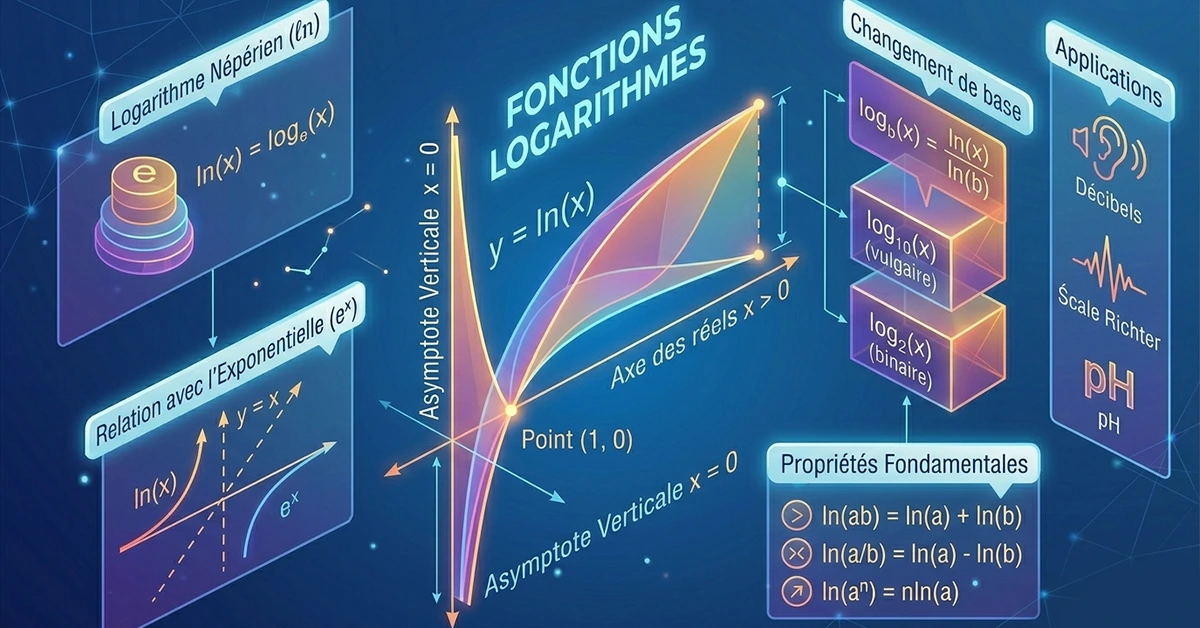
I. FONCTION LOGARITHME NÉPÉRIENNE
A. Activité
On considère la fonction $f$ définie par :
$$f: \begin{cases} ]0, +\infty[ \to \mathbb{R} \\ x \mapsto f(x) = \frac{1}{x} \end{cases}$$
- Est-ce que $f$ admet une fonction primitive sur $]0, +\infty[$ ? (Justifier votre réponse).
- Combien de fonctions primitives $F$ tel que $F(1) = 0$ ?
B. Définition
DÉFINITION :
La fonction primitive $F$ de $f(x) = \frac{1}{x}$ sur l'intervalle $]0, +\infty[$ qui s'annule en $1$ ($F(1) = 0$) s'appelle La fonction logarithme népérien et on note $F(x) = \ln(x)$.
Avec : $$F'(x) = f(x) \Leftrightarrow (\ln x)' = \frac{1}{x}$$
La fonction primitive $F$ de $f(x) = \frac{1}{x}$ sur l'intervalle $]0, +\infty[$ qui s'annule en $1$ ($F(1) = 0$) s'appelle La fonction logarithme népérien et on note $F(x) = \ln(x)$.
Avec : $$F'(x) = f(x) \Leftrightarrow (\ln x)' = \frac{1}{x}$$
C. Remarque
Au lieu d'écrire $F(x) = \ln x$, on écrit souvent $f(x) = \ln x$.
D. Conséquences
- $\ln 1 = 0$
- La fonction $f(x) = \ln x$ est définie sur $]0, +\infty[$.
- La fonction $f(x) = \ln x$ est dérivable sur $]0, +\infty[$ (car $(\ln x)' = \frac{1}{x}$).
- La fonction $f(x) = \ln x$ est continue sur $]0, +\infty[$ (car la fonction logarithme népérien est dérivable).
- La fonction $f(x) = \ln x$ est strictement croissante sur $]0, +\infty[$ (car $(\ln x)' = \frac{1}{x} > 0$).
- On en déduit : $\forall a, b \in ]0, +\infty[, \quad a < b \Leftrightarrow \ln a < \ln b$ et $\forall a, b \in ]0, +\infty[, \quad a = b \Leftrightarrow \ln a = \ln b$.
E. Exercices d'application
1. Déterminons le domaine de définition de la fonction $f(x) = \frac{3}{\ln x}$.
On a : $x \in D_f \Leftrightarrow x > 0 \text{ et } \ln x \neq 0$
$\Leftrightarrow x > 0 \text{ et } \ln x \neq \ln 1$
$\Leftrightarrow x > 0 \text{ et } x \neq 1$
$\Leftrightarrow x \in ]0, 1[ \cup ]1, +\infty[$
Conclusion : $D_f = ]0, 1[ \cup ]1, +\infty[$ ou $D_f = ]0, +\infty[ \setminus \{1\}$.
On a : $x \in D_f \Leftrightarrow x > 0 \text{ et } \ln x \neq 0$
$\Leftrightarrow x > 0 \text{ et } \ln x \neq \ln 1$
$\Leftrightarrow x > 0 \text{ et } x \neq 1$
$\Leftrightarrow x \in ]0, 1[ \cup ]1, +\infty[$
Conclusion : $D_f = ]0, 1[ \cup ]1, +\infty[$ ou $D_f = ]0, +\infty[ \setminus \{1\}$.
2. Déterminons le domaine de définition de la fonction $f(x) = \sqrt{\ln x}$.
On a : $x \in D_f \Leftrightarrow x > 0 \text{ et } \ln x \geq 0$
$\Leftrightarrow x > 0 \text{ et } \ln x \geq \ln 1$
$\Leftrightarrow x > 0 \text{ et } x \geq 1$
$\Leftrightarrow x \in [1, +\infty[$
Conclusion : $D_f = [1, +\infty[$.
On a : $x \in D_f \Leftrightarrow x > 0 \text{ et } \ln x \geq 0$
$\Leftrightarrow x > 0 \text{ et } \ln x \geq \ln 1$
$\Leftrightarrow x > 0 \text{ et } x \geq 1$
$\Leftrightarrow x \in [1, +\infty[$
Conclusion : $D_f = [1, +\infty[$.
3. Résoudre l'équation suivante : $(E): \ln(2x) - \ln(x - 1) = 0$.
Ensemble de définition :
$x \in D_E \Leftrightarrow 2x > 0 \text{ et } x - 1 > 0$
$\Leftrightarrow x > 0 \text{ et } x > 1$
$\Leftrightarrow x > 1$
Conclusion 1 : $D_E = ]1, +\infty[$.
Résolution dans $D_E$ :
$\ln(2x) - \ln(x - 1) = 0 \Leftrightarrow \ln(2x) = \ln(x - 1)$
$\Leftrightarrow 2x = x - 1$
$\Leftrightarrow x = -1$
Or $-1 \notin ]1, +\infty[$.
Conclusion 2 : L'équation $(E)$ n'a pas de solution donc $S = \emptyset$.
Ensemble de définition :
$x \in D_E \Leftrightarrow 2x > 0 \text{ et } x - 1 > 0$
$\Leftrightarrow x > 0 \text{ et } x > 1$
$\Leftrightarrow x > 1$
Conclusion 1 : $D_E = ]1, +\infty[$.
Résolution dans $D_E$ :
$\ln(2x) - \ln(x - 1) = 0 \Leftrightarrow \ln(2x) = \ln(x - 1)$
$\Leftrightarrow 2x = x - 1$
$\Leftrightarrow x = -1$
Or $-1 \notin ]1, +\infty[$.
Conclusion 2 : L'équation $(E)$ n'a pas de solution donc $S = \emptyset$.
4. Résoudre l'inéquation suivante : $(E'): \ln(2x) - \ln(x - 1) \leq 0$.
Ensemble de définition : D'après la question précédente, $D_{E'} = ]1, +\infty[$.
Résolution dans $D_{E'}$ :
$\ln(2x) - \ln(x - 1) \leq 0 \Leftrightarrow \ln(2x) \leq \ln(x - 1)$
$\Leftrightarrow 2x \leq x - 1$
$\Leftrightarrow x \leq -1$
Donc l'ensemble des solutions de l'inéquation est $]-\infty, -1] \cap ]1, +\infty[ = \emptyset$.
Conclusion 2 : L'inéquation $(E')$ n'a pas de solution donc $S = \emptyset$.
Ensemble de définition : D'après la question précédente, $D_{E'} = ]1, +\infty[$.
Résolution dans $D_{E'}$ :
$\ln(2x) - \ln(x - 1) \leq 0 \Leftrightarrow \ln(2x) \leq \ln(x - 1)$
$\Leftrightarrow 2x \leq x - 1$
$\Leftrightarrow x \leq -1$
Donc l'ensemble des solutions de l'inéquation est $]-\infty, -1] \cap ]1, +\infty[ = \emptyset$.
Conclusion 2 : L'inéquation $(E')$ n'a pas de solution donc $S = \emptyset$.
F. Signe de $\ln x$
Soit $x \in ]0, +\infty[$, on a trois cas :
- 1er cas : $x = 1$ donc $\ln 1 = 0$.
- 2ème cas : $x \in ]1, +\infty[$, donc $x > 1 \Rightarrow \ln x > \ln 1$ (c.à.d. $x > 1 \Rightarrow \ln x > 0$ car $\ln 1 = 0$).
- 3ème cas : $x \in ]0, 1[$, donc $x < 1 \Rightarrow \ln x < \ln 1$ (c.à.d. $x < 1 \Rightarrow \ln x < 0$).
| $x$ | 0 | 1 | $+\infty$ |
|---|---|---|---|
| $\ln x$ | − | 0 | + |
II. PROPRIÉTÉS ALGÉBRIQUES
A. Propriétés
Pour tous $a > 0$ et $b > 0$ et $r \in \mathbb{R}$ on a :
- $\ln(ab) = \ln a + \ln b$ (propriété admise).
- $\ln\left(\frac{1}{a}\right) = -\ln a$.
- $\ln\left(\frac{a}{b}\right) = \ln a - \ln b$.
- $\ln(a^r) = r \ln a$.
B. Preuve pour la 2ème et la 3ème
Pour la 2ème :
On a : $a > 0 \Leftrightarrow \ln 1 = 0$
$\Leftrightarrow 0 = \ln\left(a \times \frac{1}{a}\right)$
$\Leftrightarrow 0 = \ln a + \ln\left(\frac{1}{a}\right)$ (propriété n°1)
$\Leftrightarrow -\ln a = \ln\left(\frac{1}{a}\right)$
Conclusion : $\ln\left(\frac{1}{a}\right) = -\ln a$.
On a : $a > 0 \Leftrightarrow \ln 1 = 0$
$\Leftrightarrow 0 = \ln\left(a \times \frac{1}{a}\right)$
$\Leftrightarrow 0 = \ln a + \ln\left(\frac{1}{a}\right)$ (propriété n°1)
$\Leftrightarrow -\ln a = \ln\left(\frac{1}{a}\right)$
Conclusion : $\ln\left(\frac{1}{a}\right) = -\ln a$.
Pour la 3ème :
On a : $\ln\left(\frac{a}{b}\right) = \ln\left(a \times \frac{1}{b}\right)$
$= \ln a + \ln\left(\frac{1}{b}\right)$
$= \ln a - \ln b$ (propriété n°2)
Conclusion : $\ln\left(\frac{a}{b}\right) = \ln a - \ln b$.
On a : $\ln\left(\frac{a}{b}\right) = \ln\left(a \times \frac{1}{b}\right)$
$= \ln a + \ln\left(\frac{1}{b}\right)$
$= \ln a - \ln b$ (propriété n°2)
Conclusion : $\ln\left(\frac{a}{b}\right) = \ln a - \ln b$.
C. Remarque
- $\ln(a^3) = 3 \ln a$ et $\ln(\sqrt{a}) = \frac{1}{2} \ln a$.
- On écrit : $\ln(x^2) = 2 \ln x$ (pour $x > 0$).
- En général : $\forall n \in \mathbb{N}^*$, on a : $\ln(x^n) = \underbrace{\ln(x \times x \times \cdots \times x)}_{n \text{ fois}} = n \ln x$.
D. Exemple
1. Calculs numériques :
On pose $\ln 2 \approx 0,7$ et $\ln 3 \approx 1,1$. Calculons : $\ln 4$, $\ln 8$, $\ln\sqrt[3]{2}$, $\ln\sqrt{3}$, et $\ln\sqrt[3]{3^5}$.
On pose $\ln 2 \approx 0,7$ et $\ln 3 \approx 1,1$. Calculons : $\ln 4$, $\ln 8$, $\ln\sqrt[3]{2}$, $\ln\sqrt{3}$, et $\ln\sqrt[3]{3^5}$.
- $\ln 4 = \ln(2^2) = 2 \ln 2 = 2 \times 0,7 = 1,4$.
- $\ln 8 = \ln(2^3) = 3 \ln 2 = 3 \times 0,7 = 2,1$.
- $\ln\sqrt[3]{2} = \ln(2^{1/3}) = \frac{1}{3} \ln 2 = \frac{1}{3} \times 0,7 \approx 0,233$.
- $\ln\sqrt{3} = \ln(3^{1/2}) = \frac{1}{2} \ln 3 = \frac{1}{2} \times 1,1 = 0,55$.
- $\ln\sqrt[3]{3^5} = \ln(3^{5/3}) = \frac{5}{3} \ln 3 = \frac{5}{3} \times 1,1 \approx 1,833$.
2. Simplifier :
$A = 2\ln(\sqrt{3} - \sqrt{2}) + 2\ln(\sqrt{3} + \sqrt{2})$
$A = 2\left[ \ln(\sqrt{3} - \sqrt{2}) + \ln(\sqrt{3} + \sqrt{2}) \right]$
$A = 2 \ln\left[ (\sqrt{3} - \sqrt{2})(\sqrt{3} + \sqrt{2}) \right]$
$A = 2 \ln(3 - 2) = 2 \ln(1) = 0$.
Conclusion : $2\ln(\sqrt{3} - \sqrt{2}) + 2\ln(\sqrt{3} + \sqrt{2}) = 0$.
$A = 2\ln(\sqrt{3} - \sqrt{2}) + 2\ln(\sqrt{3} + \sqrt{2})$
$A = 2\left[ \ln(\sqrt{3} - \sqrt{2}) + \ln(\sqrt{3} + \sqrt{2}) \right]$
$A = 2 \ln\left[ (\sqrt{3} - \sqrt{2})(\sqrt{3} + \sqrt{2}) \right]$
$A = 2 \ln(3 - 2) = 2 \ln(1) = 0$.
Conclusion : $2\ln(\sqrt{3} - \sqrt{2}) + 2\ln(\sqrt{3} + \sqrt{2}) = 0$.
III. LIMITES
A. Propriétés
- $\lim_{x \to +\infty} \ln x = +\infty$
- $\lim_{x \to 0^+} \ln x = -\infty$
- $\lim_{x \to 0^+} x \ln x = 0$
- $\lim_{x \to +\infty} \frac{\ln x}{x} = 0$
- $\lim_{x \to +\infty} \frac{\ln x}{x^n} = 0$
- $\lim_{x \to 0^+} x^n \ln x = 0$
- $\lim_{x \to 1} \frac{\ln x}{x - 1} = 1$
- $\lim_{x \to 0} \frac{\ln(1 + x)}{x} = 1$
B. Remarques
- $\lim_{x \to 0^+} \ln x = -\infty$. Donc la courbe $(C_f)$ de $f$ admet une asymptote verticale c'est la droite d'équation $x = 0$ (l'axe des ordonnées).
- $\lim_{x \to +\infty} \ln x = +\infty$. Donc la courbe $(C_f)$ de $f$ admet une branche parabolique (à déterminer).
- $\lim_{x \to +\infty} \frac{\ln x}{x} = 0$ donc $a = 0$. Donc la courbe $(C_f)$ de $f$ admet une branche parabolique de direction l'axe des abscisses.
C. Application
1. Calculer : $\lim_{x \to +\infty} \frac{\ln(x + 2)}{x}$.
On a : $\lim_{x \to +\infty} \frac{\ln(x + 2)}{x} = \lim_{x \to +\infty} \frac{\ln(x + 2)}{x + 2} \times \frac{x + 2}{x} = 0 \times 1 = 0$.
Car :
On a : $\lim_{x \to +\infty} \frac{\ln(x + 2)}{x} = \lim_{x \to +\infty} \frac{\ln(x + 2)}{x + 2} \times \frac{x + 2}{x} = 0 \times 1 = 0$.
Car :
- $\lim_{x \to +\infty} \frac{\ln(x + 2)}{x + 2} = \lim_{t \to +\infty} \frac{\ln t}{t} = 0$ (avec $t = x + 2$).
- $\lim_{x \to +\infty} \frac{x + 2}{x} = 1$.
2. Calculer : $\lim_{x \to 0^+} x \ln x$.
On a : $\lim_{x \to 0^+} x \ln x = 0$ (propriété).
Conclusion : $\lim_{x \to 0^+} x \ln x = 0$.
On a : $\lim_{x \to 0^+} x \ln x = 0$ (propriété).
Conclusion : $\lim_{x \to 0^+} x \ln x = 0$.
3. Calculer : $\lim_{x \to 0} \frac{\ln(x^3 + 1)}{x}$.
On a : $\lim_{x \to 0} \frac{\ln(x^3 + 1)}{x} = \lim_{x \to 0} \frac{\ln(x^3 + 1)}{x^3} \times \frac{x^3}{x} = 1 \times 0 = 0$.
Car $\lim_{x \to 0} \frac{\ln(x^3 + 1)}{x^3} = 1$ (propriété) et $\lim_{x \to 0} x^2 = 0$.
Conclusion : $\lim_{x \to 0} \frac{\ln(x^3 + 1)}{x} = 0$.
On a : $\lim_{x \to 0} \frac{\ln(x^3 + 1)}{x} = \lim_{x \to 0} \frac{\ln(x^3 + 1)}{x^3} \times \frac{x^3}{x} = 1 \times 0 = 0$.
Car $\lim_{x \to 0} \frac{\ln(x^3 + 1)}{x^3} = 1$ (propriété) et $\lim_{x \to 0} x^2 = 0$.
Conclusion : $\lim_{x \to 0} \frac{\ln(x^3 + 1)}{x} = 0$.
IV. FONCTION DE LA FORME $f(x) = \ln(u(x))$
A. Remarque
On pose $g(x) = \ln x$ et la fonction $u(x)$ donc $g(u(x)) = \ln(u(x))$.
Conclusion : La fonction $f(x) = \ln(u(x))$ est la composée de deux fonctions.
Conclusion : La fonction $f(x) = \ln(u(x))$ est la composée de deux fonctions.
- Domaine de définition de $f$ : $x \in D_f \Leftrightarrow x \in D_u \text{ et } u(x) > 0$.
- Si de plus la fonction $u(x)$ est dérivable on a : $[\ln(u(x))]' = \frac{u'(x)}{u(x)}$.
- De même on a : $[\ln|u(x)|]' = \frac{u'(x)}{u(x)}$.
B. Démonstration
Pour $[\ln(u(x))]' = \frac{u'(x)}{u(x)}$ :
$f'(x) = [\ln(u(x))]' = [g(u(x))]' = g'(u(x)) \times u'(x) = \frac{1}{u(x)} \times u'(x) = \frac{u'(x)}{u(x)}$.
Car $g'(x) = (\ln x)' = \frac{1}{x}$.
Conclusion : $[\ln(u(x))]' = \frac{u'(x)}{u(x)}$.
$f'(x) = [\ln(u(x))]' = [g(u(x))]' = g'(u(x)) \times u'(x) = \frac{1}{u(x)} \times u'(x) = \frac{u'(x)}{u(x)}$.
Car $g'(x) = (\ln x)' = \frac{1}{x}$.
Conclusion : $[\ln(u(x))]' = \frac{u'(x)}{u(x)}$.
Pour $[\ln|u(x)|]' = \frac{u'(x)}{u(x)}$ :
1er cas $u(x) > 0$ : déjà démontré.
2ème cas $u(x) < 0$ :
$[\ln|u(x)|]' = [\ln(-u(x))]' = \frac{1}{-u(x)} \times (-u(x))' = \frac{1}{-u(x)} \times (-u'(x)) = \frac{u'(x)}{u(x)}$.
Conclusion : $[\ln|u(x)|]' = \frac{u'(x)}{u(x)}$.
1er cas $u(x) > 0$ : déjà démontré.
2ème cas $u(x) < 0$ :
$[\ln|u(x)|]' = [\ln(-u(x))]' = \frac{1}{-u(x)} \times (-u(x))' = \frac{1}{-u(x)} \times (-u'(x)) = \frac{u'(x)}{u(x)}$.
Conclusion : $[\ln|u(x)|]' = \frac{u'(x)}{u(x)}$.
C. Exemple
Calculons $f'$ avec $f(x) = \ln(x^2 - x)$.
On a : $f'(x) = [\ln(x^2 - x)]' = \frac{(x^2 - x)'}{x^2 - x} = \frac{2x - 1}{x^2 - x}$.
On a : $f'(x) = [\ln(x^2 - x)]' = \frac{(x^2 - x)'}{x^2 - x} = \frac{2x - 1}{x^2 - x}$.
D. Vocabulaire et remarque
- Soit $u$ fonction dérivable sur $I$ et $\forall x \in I, u(x) \neq 0$. La fonction $x \mapsto \frac{u'(x)}{u(x)}$ est appelée la dérivée logarithmique de la fonction $u$ sur $I$.
- Puisque $[\ln|u(x)|]' = \frac{u'(x)}{u(x)}$, donc les fonctions primitives de la fonction $\frac{u'(x)}{u(x)}$ sur $I$ sont les fonctions de la forme $F(x) = \ln|u(x)| + c$.
E. Exemple
1. Trouver les fonctions primitives de la fonction $f(x) = \frac{5}{x - 2}$ sur $]2, +\infty[$.
On a : $f(x) = 5 \times \frac{1}{x - 2} = 5 \times \frac{(x - 2)'}{x - 2}$.
Donc les fonctions primitives de $f$ sont de la forme $F(x) = 5 \ln|x - 2| + c$.
Puisque $x \in ]2, +\infty[$, donc $x - 2 > 0$, alors $F(x) = 5 \ln(x - 2) + c$ avec $c \in \mathbb{R}$.
On a : $f(x) = 5 \times \frac{1}{x - 2} = 5 \times \frac{(x - 2)'}{x - 2}$.
Donc les fonctions primitives de $f$ sont de la forme $F(x) = 5 \ln|x - 2| + c$.
Puisque $x \in ]2, +\infty[$, donc $x - 2 > 0$, alors $F(x) = 5 \ln(x - 2) + c$ avec $c \in \mathbb{R}$.
2. Trouver la fonction dérivée logarithmique de la fonction $u(x) = 3x^2 - 5x$.
La fonction dérivée logarithmique de $u$ est la fonction suivante : $x \mapsto \frac{6x - 5}{3x^2 - 5x}$.
La fonction dérivée logarithmique de $u$ est la fonction suivante : $x \mapsto \frac{6x - 5}{3x^2 - 5x}$.
V. ÉTUDE DE LA FONCTION $f(x) = \ln x$
- Domaine de définition : $D_f = ]0, +\infty[$.
- Continuité : $f$ est continue sur $D_f = ]0, +\infty[$.
- Limites :
- $\lim_{x \to 0^+} \ln x = -\infty$. Donc la courbe $(C_f)$ admet une asymptote verticale d'équation $x = 0$.
- $\lim_{x \to +\infty} \ln x = +\infty$. Branche parabolique de direction l'axe des abscisses car $\lim_{x \to +\infty} \frac{\ln x}{x} = 0$.
- Sens de variation :
- $f'(x) = (\ln x)' = \frac{1}{x} > 0$ sur $]0, +\infty[$.
- La fonction est strictement croissante sur $D_f$.
| $x$ | 0 | $+\infty$ | |
|---|---|---|---|
| $f'(x)$ | + | ||
| $f(x)$ | $-\infty$ | $+\infty$ | |
| 0 |
Remarque importante
- La fonction $f(x) = \ln x$ est continue et strictement croissante sur $]0, +\infty[$.
- Donc $f(]0, +\infty[) = \mathbb{R}$.
- L'équation $f(x) = 1$ admet une solution unique dans $]0, +\infty[$. On note ce nombre unique par $e \approx 2,718$ (valeur approchée) qui est un nombre irrationnel.
- Conclusion : $\ln e = 1$ et $\ln(e^r) = r; \forall r \in \mathbb{R}$.
$x \in D_f \Leftrightarrow x > 0 \text{ et } 3 - \ln x \neq 0$
$\Leftrightarrow x > 0 \text{ et } \ln x \neq 3$
$\Leftrightarrow x > 0 \text{ et } \ln x \neq \ln(e^3)$
$\Leftrightarrow x > 0 \text{ et } x \neq e^3$.
D'où : $D_f = ]0, e^3[ \cup ]e^3, +\infty[$.
VI. FONCTION LOGARITHME DE BASE $a$
A. Définition
Soit $a \in ]0, 1[ \cup ]1, +\infty[$ (c.à.d. $a$ strictement positif et différent de 1).
La fonction définie par : $$f: \begin{cases} ]0, +\infty[ \to \mathbb{R} \\ x \mapsto f(x) = \frac{\ln x}{\ln a} \end{cases}$$ S'appelle la fonction logarithme de base $a$, on note cette fonction par $f = \log_a$ d'où $f(x) = \log_a(x)$.
La fonction définie par : $$f: \begin{cases} ]0, +\infty[ \to \mathbb{R} \\ x \mapsto f(x) = \frac{\ln x}{\ln a} \end{cases}$$ S'appelle la fonction logarithme de base $a$, on note cette fonction par $f = \log_a$ d'où $f(x) = \log_a(x)$.
B. Conséquences
- $\log_a(x) = \frac{\ln x}{\ln a}$ et $\log_a(1) = 0$.
- $\log_a(a) = \frac{\ln a}{\ln a} = 1$ et $\log_a(e) = \frac{\ln e}{\ln a} = \frac{1}{\ln a}$.
C. Cas particuliers
- Cas $a = e$ : $\log_e(x) = \frac{\ln x}{\ln e} = \ln x$. Donc logarithme de base $a = e$ est le logarithme népérien.
- Cas $a = 10$ : On obtient la fonction $f(x) = \log_{10}(x)$ s'appelle la fonction logarithme décimale on note $\log_{10} = \log$ d'où $f(x) = \log(x)$.
- $\log(10^r) = r; \log(10) = 1; \log(1) = 0$.
D. Propriétés logarithme de base $a$
Soit $a \in ]0, 1[ \cup ]1, +\infty[$ et pour tout $x$ et $y$ de $]0, +\infty[$ on a :
- $\log_a(xy) = \log_a(x) + \log_a(y)$.
- $\log_a\left(\frac{1}{y}\right) = -\log_a(y)$.
- $\log_a\left(\frac{x}{y}\right) = \log_a(x) - \log_a(y)$.
- $\log_a(x^r) = r \log_a(x)$ avec $r \in \mathbb{R}$.
- $\log_a(\sqrt{x}) = \frac{1}{2} \log_a(x)$ et $\log_a(\sqrt[3]{x}) = \frac{1}{3} \log_a(x)$.
E. Démonstration
Démonstration pour $\log_a(xy) = \log_a(x) + \log_a(y)$ :
On a : $\log_a(xy) = \frac{\ln(xy)}{\ln a} = \frac{\ln x + \ln y}{\ln a} = \frac{\ln x}{\ln a} + \frac{\ln y}{\ln a} = \log_a(x) + \log_a(y)$.
Conclusion : $\log_a(xy) = \log_a(x) + \log_a(y)$.
On a : $\log_a(xy) = \frac{\ln(xy)}{\ln a} = \frac{\ln x + \ln y}{\ln a} = \frac{\ln x}{\ln a} + \frac{\ln y}{\ln a} = \log_a(x) + \log_a(y)$.
Conclusion : $\log_a(xy) = \log_a(x) + \log_a(y)$.
F. Étude de la fonction $f(x) = \log_a(x)$
- Domaine de définition : $x \in D_f \Leftrightarrow x > 0$ d'où $D_f = ]0, +\infty[$.
- Continuité : $f$ est continue sur $]0, +\infty[$.
- Limites aux bornes :
- Si $a > 1$ : $\lim_{x \to +\infty} \log_a(x) = +\infty$ et $\lim_{x \to 0^+} \log_a(x) = -\infty$.
- Si $a \in ]0, 1[$ : $\lim_{x \to +\infty} \log_a(x) = -\infty$ et $\lim_{x \to 0^+} \log_a(x) = +\infty$.
- Sens de variations :
- Dérivée : $f'(x) = (\log_a x)' = \left(\frac{\ln x}{\ln a}\right)' = \frac{1}{x \ln a}$.
- Si $a > 1$, alors $\ln a > 0$ donc $f'(x) > 0$ (fonction croissante).
- Si $a \in ]0, 1[$, alors $\ln a < 0$ donc $f'(x) < 0$ (fonction décroissante).
G. Exercices
1. Simplifier : $A = \log_2(8) - \log_2(32) + \log_2(9)$.
$A = \log_2(2^3) - \log_2(2^5) + \log_2(3^2)$
$A = 3\log_2(2) - 5\log_2(2) + 2\log_2(3)$
$A = 3 - 5 + 2\log_2(3) = -2 + 2\log_2(3)$.
$A = \log_2(2^3) - \log_2(2^5) + \log_2(3^2)$
$A = 3\log_2(2) - 5\log_2(2) + 2\log_2(3)$
$A = 3 - 5 + 2\log_2(3) = -2 + 2\log_2(3)$.
2. Simplifier : $B = \log_3\left(\frac{15}{4}\right) + \log_3\left(\frac{4}{27}\right)$.
$B = \log_3\left(\frac{15}{4} \times \frac{4}{27}\right) = \log_3\left(\frac{15}{27}\right) = \log_3\left(\frac{5}{9}\right)$
$B = \log_3(5) - \log_3(9) = \log_3(5) - 2$.
$B = \log_3\left(\frac{15}{4} \times \frac{4}{27}\right) = \log_3\left(\frac{15}{27}\right) = \log_3\left(\frac{5}{9}\right)$
$B = \log_3(5) - \log_3(9) = \log_3(5) - 2$.
3. Simplifier : $C = \log_{10}(100) - \log_{10}(10) + \log_{10}\left(\frac{1}{100}\right)$.
$C = 2 - 1 + (-2) = -1$.
$C = 2 - 1 + (-2) = -1$.
4. Montrer que : $\forall a, b \in ]1, +\infty[, \log_b(a) = \frac{1}{\log_a(b)}$.
On a : $\log_b(a) = \frac{\ln a}{\ln b}$ et $\log_a(b) = \frac{\ln b}{\ln a}$.
Donc $\frac{1}{\log_a(b)} = \frac{1}{\frac{\ln b}{\ln a}} = \frac{\ln a}{\ln b} = \log_b(a)$.
Conclusion : $\log_b(a) = \frac{1}{\log_a(b)}$.
On a : $\log_b(a) = \frac{\ln a}{\ln b}$ et $\log_a(b) = \frac{\ln b}{\ln a}$.
Donc $\frac{1}{\log_a(b)} = \frac{1}{\frac{\ln b}{\ln a}} = \frac{\ln a}{\ln b} = \log_b(a)$.
Conclusion : $\log_b(a) = \frac{1}{\log_a(b)}$.
5. Résoudre dans $\mathbb{R}$ l'équation : $\log_3(2x) \times \log_5(x - 1) = 0$.
Domaine de définition : $2x > 0$ et $x - 1 > 0 \Leftrightarrow x > 0$ et $x > 1 \Leftrightarrow x > 1$.
$D_E = ]1, +\infty[$.
Résolution :
$\log_3(2x) = 0$ ou $\log_5(x - 1) = 0$
$\Leftrightarrow 2x = 1$ ou $x - 1 = 1$
$\Leftrightarrow x = \frac{1}{2}$ ou $x = 2$.
Or $\frac{1}{2} \notin ]1, +\infty[$ et $2 \in ]1, +\infty[$.
Conclusion : $S = \{2\}$.
Domaine de définition : $2x > 0$ et $x - 1 > 0 \Leftrightarrow x > 0$ et $x > 1 \Leftrightarrow x > 1$.
$D_E = ]1, +\infty[$.
Résolution :
$\log_3(2x) = 0$ ou $\log_5(x - 1) = 0$
$\Leftrightarrow 2x = 1$ ou $x - 1 = 1$
$\Leftrightarrow x = \frac{1}{2}$ ou $x = 2$.
Or $\frac{1}{2} \notin ]1, +\infty[$ et $2 \in ]1, +\infty[$.
Conclusion : $S = \{2\}$.
6. Résoudre l'inéquation : $\log_3(3x - 1) \geq \log_3(x + 1)$.
Domaine de définition : $3x - 1 > 0$ et $x + 1 > 0 \Leftrightarrow x > \frac{1}{3}$ et $x > -1 \Leftrightarrow x > \frac{1}{3}$.
$D_{E'} = ]\frac{1}{3}, +\infty[$.
Résolution :
$\log_3(3x - 1) \geq \log_3(x + 1) \Leftrightarrow 3x - 1 \geq x + 1$ (car $a = 3 > 1$)
$\Leftrightarrow 2x \geq 2 \Leftrightarrow x \geq 1$.
Conclusion : $S = [1, +\infty[ \cap ]\frac{1}{3}, +\infty[ = [1, +\infty[$.
Domaine de définition : $3x - 1 > 0$ et $x + 1 > 0 \Leftrightarrow x > \frac{1}{3}$ et $x > -1 \Leftrightarrow x > \frac{1}{3}$.
$D_{E'} = ]\frac{1}{3}, +\infty[$.
Résolution :
$\log_3(3x - 1) \geq \log_3(x + 1) \Leftrightarrow 3x - 1 \geq x + 1$ (car $a = 3 > 1$)
$\Leftrightarrow 2x \geq 2 \Leftrightarrow x \geq 1$.
Conclusion : $S = [1, +\infty[ \cap ]\frac{1}{3}, +\infty[ = [1, +\infty[$.
7. Étudier la fonction : $f(x) = \log_5(x + 1)$.
- Domaine : $x + 1 > 0 \Leftrightarrow x > -1$. $D_f = ]-1, +\infty[$.
- Limites :
- $\lim_{x \to -1^+} f(x) = -\infty$ (Asymptote verticale $x = -1$).
- $\lim_{x \to +\infty} f(x) = +\infty$.
- Branches infinies : $\lim_{x \to +\infty} \frac{f(x)}{x} = 0$. Branche parabolique de direction l'axe des abscisses.
- Variations : $f'(x) = \frac{1}{(x + 1)\ln 5} > 0$ sur $]-1, +\infty[$. Fonction strictement croissante.