
Fonctions exponentielles
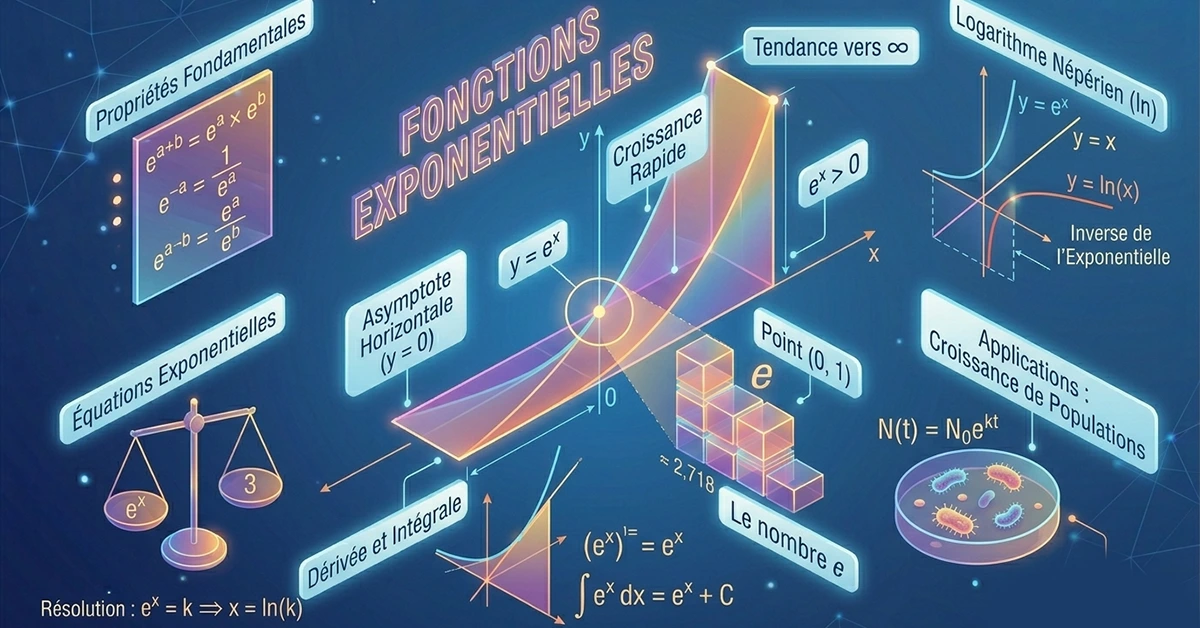
I. LA FONCTION EXPONENTIELLE NÉPÉRIENNE
A. Activité
On considère la fonction $f$ définie par:
$$f: \begin{cases} ]0, +\infty[ \to \mathbb{R} \\ x \mapsto f(x) = \ln x \end{cases}$$ Question: Est-ce que la fonction $f$ admet une fonction réciproque $f^{-1}$?
$$f: \begin{cases} ]0, +\infty[ \to \mathbb{R} \\ x \mapsto f(x) = \ln x \end{cases}$$ Question: Est-ce que la fonction $f$ admet une fonction réciproque $f^{-1}$?
B. Vocabulaire et Notation
La fonction réciproque $f^{-1}$ de $f$ est appelée la fonction exponentielle népérienne (ou la fonction exponentielle), on note:
$$f^{-1} = \exp \quad \text{ou} \quad f^{-1} = e$$
$$f^{-1} = \exp \quad \text{ou} \quad f^{-1} = e$$
C. Définition et Propriété
La fonction $f$ définie par:
$$f: \begin{cases} ]0, +\infty[ \to \mathbb{R} \\ x \mapsto f(x) = \ln x \end{cases}$$ est continue et strictement croissante sur l'intervalle $]0, +\infty[$ d'où $f$ admet une fonction réciproque $f^{-1}$, on l'appelle fonction exponentielle népérienne et on la note par:
$$f^{-1} = \exp \quad \text{ou} \quad f^{-1} = e$$ avec:
$$f^{-1} = \exp: \mathbb{R} \to ]0, +\infty[$$ $$x \mapsto \exp(x) = f^{-1}(x)$$
$$f: \begin{cases} ]0, +\infty[ \to \mathbb{R} \\ x \mapsto f(x) = \ln x \end{cases}$$ est continue et strictement croissante sur l'intervalle $]0, +\infty[$ d'où $f$ admet une fonction réciproque $f^{-1}$, on l'appelle fonction exponentielle népérienne et on la note par:
$$f^{-1} = \exp \quad \text{ou} \quad f^{-1} = e$$ avec:
$$f^{-1} = \exp: \mathbb{R} \to ]0, +\infty[$$ $$x \mapsto \exp(x) = f^{-1}(x)$$
D. Conséquences
- La fonction exponentielle népérienne $f^{-1} = \exp$ ou $f^{-1} = e$ est continue et strictement croissante sur $\mathbb{R}$ et la courbe de $f^{-1}$ et $f$ sont symétriques par rapport à la 1ère bissectrice (la droite d'équation $D: y = x$).
- $\forall x \in \mathbb{R}, \exp(x) > 0$.
- Relation entre $f(x) = \ln x$ et $f^{-1}(x) = \exp(x)$ est:
$$\exp(x) = y \Leftrightarrow \begin{cases} x = \ln y \\ y \in ]0, +\infty[ \end{cases}$$ - On a: $\forall x \in ]0, +\infty[: f^{-1}(f(x)) = x \Leftrightarrow f(f^{-1}(x)) = x$ donc:
$$\forall x \in ]0, +\infty[, \exp(\ln x) = x \Leftrightarrow \exp(\ln x) = x$$ - On a: $\forall x \in \mathbb{R}: f^{-1}(f(x)) = x \Leftrightarrow f(f^{-1}(x)) = x$ donc:
$$\forall x \in \mathbb{R}, \ln(\exp x) = x \Leftrightarrow \ln(\exp x) = x$$
E. Nouvelle Notation
On sait que: $\forall r \in \mathbb{R}: r = \ln(e^r)$ d'où:
$$\forall r \in \mathbb{R}, \exp(r) = \exp(\ln e^r) \Leftrightarrow \forall r \in \mathbb{R}, \exp(r) = e^r$$ On obtient: $\forall r \in \mathbb{R}: \exp(r) = e^r$ par conséquence on va prolonger ce résultat à tous les nombres réels $x$.
D'où la nouvelle notation:
$$\forall x \in \mathbb{R}: \exp(x) = e^x$$ Donc:
$$f^{-1} = \exp: \mathbb{R} \to ]0, +\infty[$$ $$x \mapsto \exp(x) = e^x$$
$$\forall r \in \mathbb{R}, \exp(r) = \exp(\ln e^r) \Leftrightarrow \forall r \in \mathbb{R}, \exp(r) = e^r$$ On obtient: $\forall r \in \mathbb{R}: \exp(r) = e^r$ par conséquence on va prolonger ce résultat à tous les nombres réels $x$.
D'où la nouvelle notation:
$$\forall x \in \mathbb{R}: \exp(x) = e^x$$ Donc:
$$f^{-1} = \exp: \mathbb{R} \to ]0, +\infty[$$ $$x \mapsto \exp(x) = e^x$$
F. Propriétés
- $e^x = y \Leftrightarrow \begin{cases} x = \ln y \\ y > 0 \end{cases}$ et $\forall x > 0: e^{\ln x} = x$ et $\forall x \in \mathbb{R}: \ln(e^x) = x$ et $\forall x \in \mathbb{R}, e^x > 0$.
- $\forall a, b \in \mathbb{R}: a = b \Leftrightarrow e^a = e^b$ et $\forall a, b \in \mathbb{R}: a < b \Leftrightarrow e^a < e^b$.
G. Exemples
1. Résoudre l'équation: $e^x - 3 = 0$
$$e^x - 3 = 0 \Leftrightarrow e^x = 3 \Leftrightarrow x = \ln 3$$ Ensemble des solutions de l'équation est $S = \{\ln 3\}$.
$$e^x - 3 = 0 \Leftrightarrow e^x = 3 \Leftrightarrow x = \ln 3$$ Ensemble des solutions de l'équation est $S = \{\ln 3\}$.
2. Calculs:
$$e^{\ln 24} = 24 \quad \text{et} \quad \ln(e^{-13}) = -13$$
$$e^{\ln 24} = 24 \quad \text{et} \quad \ln(e^{-13}) = -13$$
3. Résoudre l'équation suivante: $e^{x+3} = e^{2x+7}$
$$e^{x+3} = e^{2x+7} \Leftrightarrow x + 3 = 2x + 7 \Leftrightarrow x = -4$$ Ensemble des solutions de l'équation est $S = \{-4\}$.
$$e^{x+3} = e^{2x+7} \Leftrightarrow x + 3 = 2x + 7 \Leftrightarrow x = -4$$ Ensemble des solutions de l'équation est $S = \{-4\}$.
4. Résoudre l'inéquation suivante: $e^{x+1} < e^{6x-2}$
$$e^{x+1} < e^{6x-2} \Leftrightarrow x + 1 < 6x - 2$$ $$\Leftrightarrow -5x < -3 \Leftrightarrow x > \frac{3}{5}$$ $$\Leftrightarrow x \in \left]\frac{3}{5}, +\infty\right[$$ Ensemble des solutions de l'inéquation est: $S = \left]\frac{3}{5}, +\infty\right[$.
$$e^{x+1} < e^{6x-2} \Leftrightarrow x + 1 < 6x - 2$$ $$\Leftrightarrow -5x < -3 \Leftrightarrow x > \frac{3}{5}$$ $$\Leftrightarrow x \in \left]\frac{3}{5}, +\infty\right[$$ Ensemble des solutions de l'inéquation est: $S = \left]\frac{3}{5}, +\infty\right[$.
5. Ensemble de définition des fonctions: $f(x) = \frac{2}{e^x}$ et $g(x) = \sqrt{e^x}$
- $x \in D_f \Leftrightarrow e^x \neq 0$ ceci est vrai quelque soit $x$ de $\mathbb{R}$ car $e^x > 0$ donc $D_f = \mathbb{R}$.
- $x \in D_g \Leftrightarrow e^x \geq 0$ on sait quelque soit $x$ de $\mathbb{R}$ on a $e^x > 0$ donc $D_g = \mathbb{R}$.
II. PROPRIÉTÉS ALGÉBRIQUES
A. Propriétés
Soient $a$ et $b$ et $x$ de $\mathbb{R}$ et $r \in \mathbb{R}$ on a:
| Exemples | Propriétés | Exemples | Propriétés |
|---|---|---|---|
| $(e^x)^3 = e^{3x}$ | $(e^x)^r = e^{rx}$ $(r \in \mathbb{R})$ | $e^7 = e^4 \times e^3$ | $e^{a+b} = e^a \times e^b$ |
| $e^{-x} = \frac{1}{e^x}$ | $e^{-x} = \frac{1}{e^x}$ | $\frac{1}{e^2} = e^{-2}$ | $e^{-b} = \frac{1}{e^b}$ |
| $(e^{2x+1})^3 = e^{6x+3}$ | $(e^{ax+b})^r = e^{r(ax+b)}$ | $\frac{e^7}{e^2} = e^5$ | $\frac{e^a}{e^b} = e^{a-b}$ |
B. Preuve
Pour $e^{a+b} = e^a \times e^b$:
On pose: $A = e^{a+b}$ et $B = e^a \times e^b$
On a:
$$A = e^{a+b} \Leftrightarrow \ln A = \ln(e^{a+b})$$ $$\Leftrightarrow \ln A = a + b \quad (1)$$ Et:
$$B = e^a \times e^b \Leftrightarrow \ln B = \ln(e^a \times e^b)$$ $$\Leftrightarrow \ln B = \ln(e^a) + \ln(e^b)$$ $$\Leftrightarrow \ln B = a + b \quad (2)$$ D'après $(1)$ et $(2)$ on obtient: $\ln A = \ln B$ donc $A = B$ c.à.d. $e^{a+b} = e^a \times e^b$.
Conclusion: $e^{a+b} = e^a \times e^b$.
On pose: $A = e^{a+b}$ et $B = e^a \times e^b$
On a:
$$A = e^{a+b} \Leftrightarrow \ln A = \ln(e^{a+b})$$ $$\Leftrightarrow \ln A = a + b \quad (1)$$ Et:
$$B = e^a \times e^b \Leftrightarrow \ln B = \ln(e^a \times e^b)$$ $$\Leftrightarrow \ln B = \ln(e^a) + \ln(e^b)$$ $$\Leftrightarrow \ln B = a + b \quad (2)$$ D'après $(1)$ et $(2)$ on obtient: $\ln A = \ln B$ donc $A = B$ c.à.d. $e^{a+b} = e^a \times e^b$.
Conclusion: $e^{a+b} = e^a \times e^b$.
C. Remarques
- $(e^x)^2 = e^x \times e^x = e^{2x}$ et $(e^x)^3 = e^x \times e^x \times e^x = e^{3x}$.
- $(e^x)^n = \underbrace{e^x \times e^x \times \cdots \times e^x}_{n \text{ fois}} = e^{nx}$.
- $f(x) = e^{u(x)}$, $x \in D_f \Leftrightarrow x \in D_u$.
III. LIMITES
| $\displaystyle\lim_{x \to -\infty} e^x = 0$ | $\displaystyle\lim_{x \to +\infty} e^x = +\infty$ |
| $\displaystyle\lim_{x \to 0} \frac{e^x - 1}{x} = 1$ | $\displaystyle\lim_{x \to -\infty} x \times e^x = 0$ |
| $\displaystyle\lim_{x \to -\infty} x^n \times e^x = 0$; $n \in \mathbb{N}^*$ | $\displaystyle\lim_{x \to +\infty} \frac{e^x}{x} = +\infty$ |
| $\displaystyle\lim_{x \to +\infty} \frac{e^x}{x^n} = +\infty$; $n \in \mathbb{N}^*$ |
A. Exemple
1. Calculer: $\displaystyle\lim_{x \to +\infty} \frac{e^{2x}}{x}$
1ère méthode:
$$\lim_{x \to +\infty} \frac{e^{2x}}{x} = \lim_{x \to +\infty} \frac{e^x \times e^x}{x} = \lim_{x \to +\infty} \frac{e^x}{x} \times e^x = +\infty$$ 2ème méthode:
$$\lim_{x \to +\infty} \frac{e^{2x}}{x} = \lim_{x \to +\infty} \frac{e^{2x}}{2x} \times 2$$ $$= \lim_{t \to +\infty} \frac{e^t}{t} \times 2 \quad (\text{avec } t = 2x; x \to +\infty \Rightarrow t \to +\infty)$$ $$= +\infty$$
1ère méthode:
$$\lim_{x \to +\infty} \frac{e^{2x}}{x} = \lim_{x \to +\infty} \frac{e^x \times e^x}{x} = \lim_{x \to +\infty} \frac{e^x}{x} \times e^x = +\infty$$ 2ème méthode:
$$\lim_{x \to +\infty} \frac{e^{2x}}{x} = \lim_{x \to +\infty} \frac{e^{2x}}{2x} \times 2$$ $$= \lim_{t \to +\infty} \frac{e^t}{t} \times 2 \quad (\text{avec } t = 2x; x \to +\infty \Rightarrow t \to +\infty)$$ $$= +\infty$$
2. Calculer: $\displaystyle\lim_{x \to +\infty} \frac{e^x + 2x^3}{x}$
On a:
$$\lim_{x \to +\infty} \frac{e^x + 2x^3}{x} = \lim_{x \to +\infty} \frac{e^x}{x} + \frac{2x^3}{x} = +\infty + 0 = +\infty$$ (car $\displaystyle\lim_{x \to +\infty} \frac{e^x}{x} = +\infty$ et $\displaystyle\lim_{x \to +\infty} \frac{2}{x^2} = 0$)
On a:
$$\lim_{x \to +\infty} \frac{e^x + 2x^3}{x} = \lim_{x \to +\infty} \frac{e^x}{x} + \frac{2x^3}{x} = +\infty + 0 = +\infty$$ (car $\displaystyle\lim_{x \to +\infty} \frac{e^x}{x} = +\infty$ et $\displaystyle\lim_{x \to +\infty} \frac{2}{x^2} = 0$)
IV. DÉRIVÉE DE LA FONCTION $f(x) = e^x$ ET $f(x) = e^{u(x)}$
A. Théorème
La fonction $f(x) = e^x$ est dérivable sur $\mathbb{R}$ et on a:
$$\forall x \in \mathbb{R}: (e^x)' = e^x$$
$$\forall x \in \mathbb{R}: (e^x)' = e^x$$
B. Preuve
On pose: $f(x) = \ln x$ et $f^{-1}(x) = \exp(x)$.
La fonction $f$ est dérivable sur $]0, +\infty[$ et sa fonction dérivée est $f'(x) = \frac{1}{x}$ qui ne s'annule pas sur $]0, +\infty[$ donc sa fonction réciproque $f^{-1}$ est dérivable sur $f(]0, +\infty[) = \mathbb{R}$ et:
$$\forall x \in \mathbb{R}: (e^x)' = (f^{-1})'(x) = \frac{1}{f'(f^{-1}(x))} = \frac{1}{f'(e^x)} = \frac{1}{\frac{1}{e^x}} = e^x$$ Conclusion: $\forall x \in \mathbb{R}: (e^x)' = e^x$.
La fonction $f$ est dérivable sur $]0, +\infty[$ et sa fonction dérivée est $f'(x) = \frac{1}{x}$ qui ne s'annule pas sur $]0, +\infty[$ donc sa fonction réciproque $f^{-1}$ est dérivable sur $f(]0, +\infty[) = \mathbb{R}$ et:
$$\forall x \in \mathbb{R}: (e^x)' = (f^{-1})'(x) = \frac{1}{f'(f^{-1}(x))} = \frac{1}{f'(e^x)} = \frac{1}{\frac{1}{e^x}} = e^x$$ Conclusion: $\forall x \in \mathbb{R}: (e^x)' = e^x$.
C. Théorème
Si la fonction $u(x)$ est dérivable sur un intervalle $I$ alors la fonction $f(x) = e^{u(x)}$ est dérivable sur $I$ et sa fonction dérivée est:
$$f'(x) = [e^{u(x)}]' = u'(x) \times e^{u(x)}$$
$$f'(x) = [e^{u(x)}]' = u'(x) \times e^{u(x)}$$
D. Exemple
Soit la fonction $f(x) = e^{5x + 3x^3}$
On a:
$$f'(x) = [e^{5x + 3x^3}]' = (5x + 3x^3)' \times e^{5x + 3x^3} = (5 + 9x^2) \times e^{5x + 3x^3}$$
On a:
$$f'(x) = [e^{5x + 3x^3}]' = (5x + 3x^3)' \times e^{5x + 3x^3} = (5 + 9x^2) \times e^{5x + 3x^3}$$
E. Remarque
Les fonctions primitives de la fonction $g(x) = u'(x) \times e^{u(x)}$ sont les fonctions de la forme:
$$G(x) = e^{u(x)} + c; \quad c \in \mathbb{R}$$
$$G(x) = e^{u(x)} + c; \quad c \in \mathbb{R}$$
F. Exemple
On détermine les primitives de la fonction $f(x) = x \times e^{3x^2 + 1}$ sont les fonctions de la forme:
$$F(x) = \frac{1}{6} e^{3x^2 + 1} + c$$
$$F(x) = \frac{1}{6} e^{3x^2 + 1} + c$$
V. ÉTUDE DE LA FONCTION $f(x) = e^x$
Tableau de Variation de $f$:
| $x$ | $-\infty$ | $+\infty$ | |
|---|---|---|---|
| $f'$ | + | ||
| $f$ | $0$ | $+\infty$ |
La Courbe Représentative de $f$:
- La courbe admet une asymptote horizontale d'équation $y = 0$ au voisinage de $-\infty$.
- La courbe admet une branche parabolique de direction l'axe des ordonnées au voisinage de $+\infty$.
- La fonction est strictement croissante sur $\mathbb{R}$.
VI. FONCTION EXPONENTIELLE DE BASE $a$ AVEC $a \in ]0, 1[ \cup ]1, +\infty[$
A. Définition
Soit $a \in ]0, 1[ \cup ]1, +\infty[$.
La fonction définie par:
$$\forall x > 0, \log_a(x) = \frac{\ln x}{\ln a}$$ est continue et strictement monotone sur $]0, +\infty[$ donc elle admet une fonction réciproque $f^{-1}$, on l'appelle fonction exponentielle de base $a$ et définie par:
$$f^{-1}: \mathbb{R} \to ]0, +\infty[$$ $$x \mapsto f^{-1}(x) = \exp_a(x)$$
La fonction définie par:
$$\forall x > 0, \log_a(x) = \frac{\ln x}{\ln a}$$ est continue et strictement monotone sur $]0, +\infty[$ donc elle admet une fonction réciproque $f^{-1}$, on l'appelle fonction exponentielle de base $a$ et définie par:
$$f^{-1}: \mathbb{R} \to ]0, +\infty[$$ $$x \mapsto f^{-1}(x) = \exp_a(x)$$
B. Nouvelle Notation
- On a:
$$f^{-1}(x) = y \Leftrightarrow f(y) = x$$ $$\Leftrightarrow \log_a(y) = x$$ $$\Leftrightarrow \frac{\ln y}{\ln a} = x$$ $$\Leftrightarrow \ln y = x \ln a$$ $$\Leftrightarrow y = e^{x \ln a}$$ D'où $f^{-1}(x) = \exp_a(x) = e^{x \ln a}$ - On prend $x = r \in \mathbb{R}$ on a:
$$f^{-1}(r) = \exp_a(r) = e^{r \ln a} = (e^{\ln a})^r = a^r$$ d'où: $\exp_a(r) = a^r$. - On prolonge cette écriture pour tous les nombres réels $x$ de $\mathbb{R}$ on obtient:
$$\forall x \in \mathbb{R}, f^{-1}(x) = e^{x \ln a} = a^x$$
C. Exemple
$$5^x = e^{x \ln 5} \quad \text{et} \quad \left(\frac{1}{5}\right)^x = e^{-x \ln 5} \quad \text{et} \quad 10^x = e^{x \ln 10}$$
D. Remarques
- Pour tout $x$ de $\mathbb{R}$ on a: $\log_a(a^x) = x$.
- Pour tout $x > 0$ on a: $a^{\log_a(x)} = x$.
- Pour tout $x$ de $\mathbb{R}$ on a: $10^x = y \Leftrightarrow x = \text{Log}(y)$.
E. Conséquences
Soit $a \in ]0, 1[ \cup ]1, +\infty[$ et la fonction $f(x) = a^x = e^{x \ln a}$.
- La fonction $f$ est continue et dérivable sur l'intervalle $\mathbb{R}$.
- $[f(x)]' = [a^x]' = [\ln a \times e^{x \ln a}]' = \ln a \times a^x$.
- D'où le signe: $[f(x)]' = [a^x]' = \ln a \times a^x$ est le signe de $\ln a$.
- $0 < a < 1$ alors $f(x) = a^x = e^{x \ln a}$ strictement décroissante d'où: $\forall (x, y) \in \mathbb{R}^2: a^x < a^y \Leftrightarrow x > y$.
- $a > 1$ alors $f(x) = a^x = e^{x \ln a}$ strictement croissante d'où: $\forall (x, y) \in \mathbb{R}^2: a^x < a^y \Leftrightarrow x < y$.
F. Propriétés
$a \in ]0, 1[ \cup ]1, +\infty[$ et $r \in \mathbb{R}$, $\forall x, y \in \mathbb{R}$ on a:
- $a^{x+y} = a^x \times a^y$
- $(a^x)^y = a^{x \times y}$
- $a^{-x} = \frac{1}{a^x}$
- $\frac{a^x}{a^y} = a^{x-y}$
G. La Courbe Représentative de $f(x) = a^x$ avec $a \in ]0, 1[ \cup ]1, +\infty[$
- Cas $0 < a < 1$: on prend $a = \frac{1}{2}$ donc $f(x) = \left(\frac{1}{2}\right)^x$.
- Cas $a > 1$: on prend $a = 2$ donc $f(x) = 2^x$.
H. Exemple
1. Écrire la fonction $f(x) = 3^{x^3 - x}$ en fonction de la fonction exponentielle népérienne.
On a:
$$f(x) = 3^{x^3 - x} = e^{(x^3 - x)\ln 3}$$
On a:
$$f(x) = 3^{x^3 - x} = e^{(x^3 - x)\ln 3}$$
2. Calculer: $\displaystyle\lim_{x \to +\infty} f(x)$ et $\displaystyle\lim_{x \to -\infty} f(x)$.
- $\displaystyle\lim_{x \to +\infty} f(x) = \lim_{x \to +\infty} e^{(x^3 - x)\ln 3} = +\infty$ car $\displaystyle\lim_{x \to +\infty} (x^3 - x) = +\infty$ et $\displaystyle\lim_{t \to +\infty} e^t = +\infty$.
- $\displaystyle\lim_{x \to -\infty} f(x) = \lim_{x \to -\infty} e^{(x^3 - x)\ln 3} = 0$ car $\displaystyle\lim_{x \to -\infty} (x^3 - x) = -\infty$ et $\displaystyle\lim_{t \to -\infty} e^t = 0$.
3. Calculer: $f'$ la fonction dérivée de $f$.
On a:
$$f'(x) = \frac{d}{dx}\left(e^{(x^3 - x)\ln 3}\right) = (x^3 - x)' \times \ln 3 \times e^{(x^3 - x)\ln 3} = (3x^2 - 1) \times \ln 3 \times e^{(x^3 - x)\ln 3}$$
On a:
$$f'(x) = \frac{d}{dx}\left(e^{(x^3 - x)\ln 3}\right) = (x^3 - x)' \times \ln 3 \times e^{(x^3 - x)\ln 3} = (3x^2 - 1) \times \ln 3 \times e^{(x^3 - x)\ln 3}$$